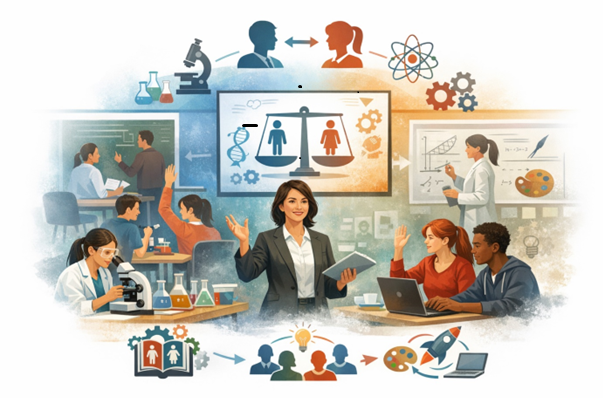
| The introduction of gender sensitive pedagogy into higher education is gaining increasing importance, particularly within STEM disciplines, where traditional teaching practices often fail to address the diverse educational needs of female and male students. Research consistently shows that classroom interactions, language use, and access to leadership roles tend to favor male students, thereby perpetuating existing inequalities. Counteracting these tendencies requires systematic training of academic staff and a comprehensive review of curricula to ensure that all learners—regardless of gender—can participate fully and equitably in the educational process. In this context, the ST3AM project places particular emphasis on reforming STEM education through a gender inclusive perspective. Its objectives include redesigning curricula and teaching methods, equipping academic teachers with resources to create inclusive lesson plans, and supporting female students in enhancing their learning experiences. This approach also integrates STEAM principles, combining creativity and interdisciplinarity with the traditionally technocratic STEM environment. These actions align with the broader ST3AM mission, which aims to build inclusive educational ecosystems, promote women’s leadership and research activity, and foster interdisciplinary collaboration to counter gender bias in STEM. By engaging external partners and raising awareness of gender equality, the initiative seeks to achieve a longterm sociotechnical impact on both education and the labor market. A key activity involves developing a blended reformational program that places the learner at the center of the process. Based on previous findings, the program addresses inclusion challenges in both quantitative and qualitative dimensions. Its implementation follows clearly defined stages: -Alpha Phase: Gathering information on gender sensitive teaching practices, examples, and practical guidelines to support module development. -Design Phase: Creating the structure of educational materials, including visual elements and module distribution. -Development Phase: Preparing educational modules that incorporate gender considerations, aimed at reforming STEM curricula through teaching techniques, inclusive language, identification of biased examples, and STEAM based career-orientation strategies. -Beta Classrooms: Testing and refining modules through interactive workshops. At least five professors and ten students from partner universities will participate in the evaluation process, providing feedback essential for finalizing the materials. The Beta Classroom workshops will be held in the first week of June 2026 at Lodz University of Technology. At least five lecturers and ten students will take part in the ST3AM Beta Classrooms. These workshops represent a crucial validation stage, ensuring that the educational content is effective and tailored to user needs. The main goal is to work together to create educational materials that take gender differences into account to improve STEM courses using appropriate teaching methods, inclusive language, identifying bias, and career advice based on the STEAM approach. The approval process will include planned surveys given to both teachers and students. These surveys will help check the quality of the materials, how well the teaching methods work, and how helpful they are for improving STEM courses. The goal is to reach at least an 85% satisfaction rate among participants in the Beta Class workshops. TUL team: Volodymyr Mosorov, Beata Radziłowska-Matusiak Edyta Zientalak-Orłowska |